
4 Elements to Transform Island Distilleries: Solar, Heat Pumps, Thermal Storage, and Breadfruit
Building a distillery on a small island creates an unusual energy problem. Distillation requires substantial process heat while fermentation and condensation require cooling. Meanwhile, the dependable electrical and bulk energy supply on many islands is ultimately tied to imported fossil fuels.
Solar generation can reduce that dependence, but without a wholistic plan of attack, doesn’t come close to eliminating it.
Storage is Everything
Most small industrial facilities, much less small distilleries, don’t have enough battery storage to carry major thermal loads through cloud cover, nighttime operation, or other periods of reduced solar production. A large electric resistance boiler, the standard in electric steam generation, therefore doesn’t become a truly solar-powered heat source simply because photovoltaic panels are installed on the property. When solar production falls, the heater draws from the grid – and the grid may be generating that electricity from imported diesel or other fossil fuels.
More importantly, resistance heating addresses only half of the thermal problem.
The solution wasn’t simply to put solar panels on a conventional distillery. It was to redesign the process around the resources and limitations of the island itself.
A distillery needs heat and cooling. Luckily, there’s a solution: high temperature heat pumps tied to thermal storage.
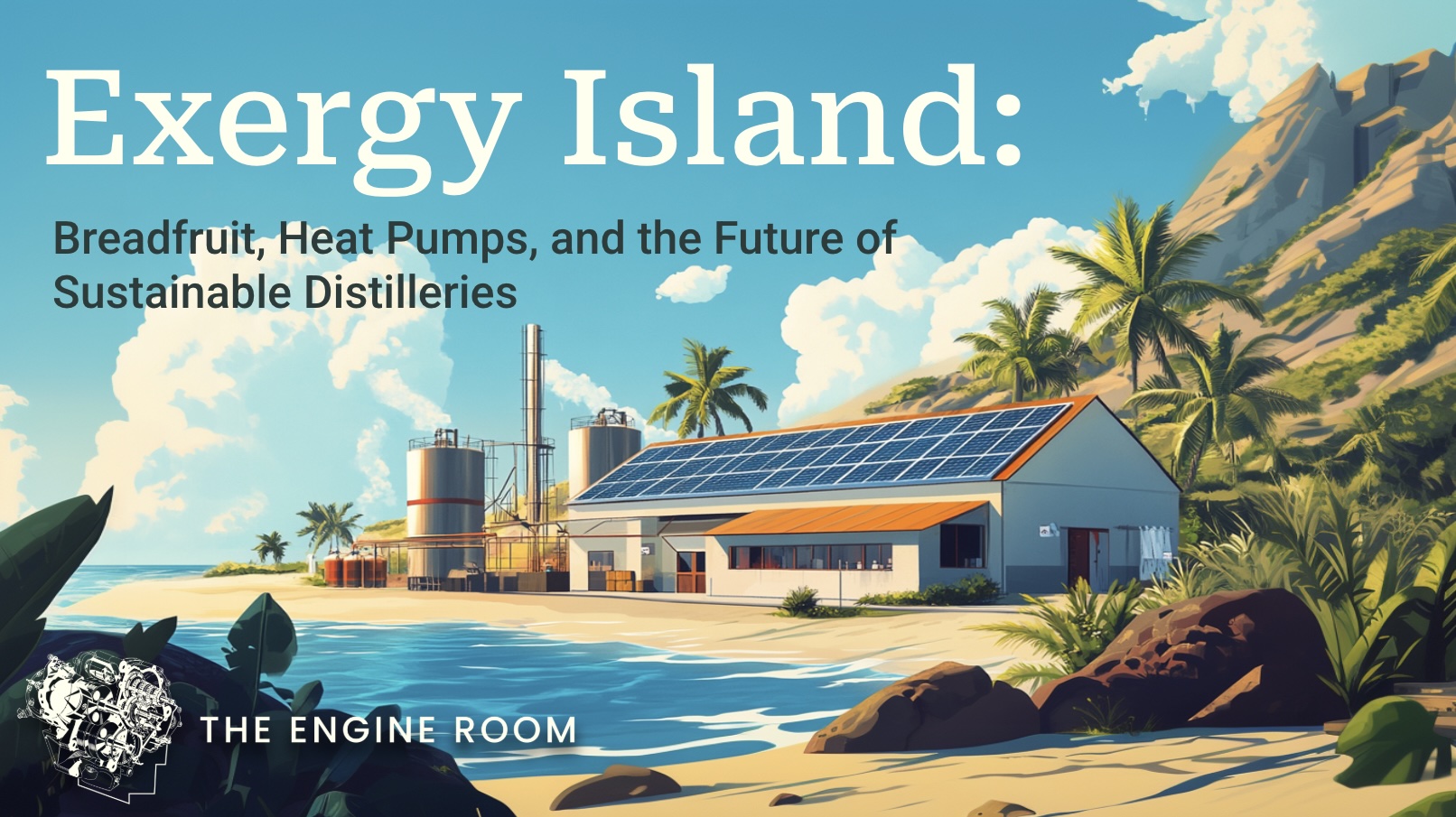
That distinction was central to our presentation – “Exergy Island” – exploring how four elements – solar power, heat pumps, thermal storage, and the mostly unknown breadfruit – could be combined to make distilling practical in an island environment where conventional process heating and cooling could otherwise be prohibitively expensive and environmentally difficult to justify.
The solution wasn’t simply to put solar panels on a conventional distillery, it was to redesign the process around the resources and limitations of the island itself.
Heat Pumps Do Two Jobs
A heat pump doesn’t use electricity simply to make heat. It uses electricity to move heat. That difference matters.
On the hot side, a high temperature heat pump can provide substantially more useful thermal energy than the electrical energy consumed by the compressor. At the same time, all of that transferred heat has to come from somewhere. In this case, it’s pulled from a water cistern.
As the heat pump supplies process heat to the distillery, the water in the cistern gets colder. That gives the facility something else it already needs: process cooling.
One electrical load is now doing two useful jobs.
A resistance heater can’t do that. It consumes electricity to make heat, and the distillery still needs another system to cool fermentation, condense vapor, chill process streams, or provide cooling elsewhere in the facility. On an island where reliable electricity is expensive and closely tied to imported fuel, that changes the economics considerably.
The important comparison isn’t simply how efficiently an electric heater converts electricity into heat – it’s how much useful heating and cooling work the facility can accomplish with the electricity it has available.
For a more in-depth look into this technology, check out our other presentations: The Future of Fire and Reinventing Fire
Thermal Storage Doesn’t Have to Mean Batteries
Solar’s biggest limitation isn’t that it doesn’t work. It’s that it doesn’t work all the time. A cloud passes overhead, production continues after sunset, and process demand changes throughout the day. Batteries can bridge those gaps, but storing enough electricity to support large industrial thermal loads gets expensive quickly, especially for a small facility.
If what the process ultimately needs is heat and cold, there’s another option: store thermal energy instead of trying to store all of the electricity. A water cistern or reservoir provides a large amount of thermal mass, and when it’s integrated with the heat pump system it becomes more than just a tank of water. It’s part of the cooling system, part of the thermal storage system, and part of the strategy for making intermittent solar generation useful to an industrial process.
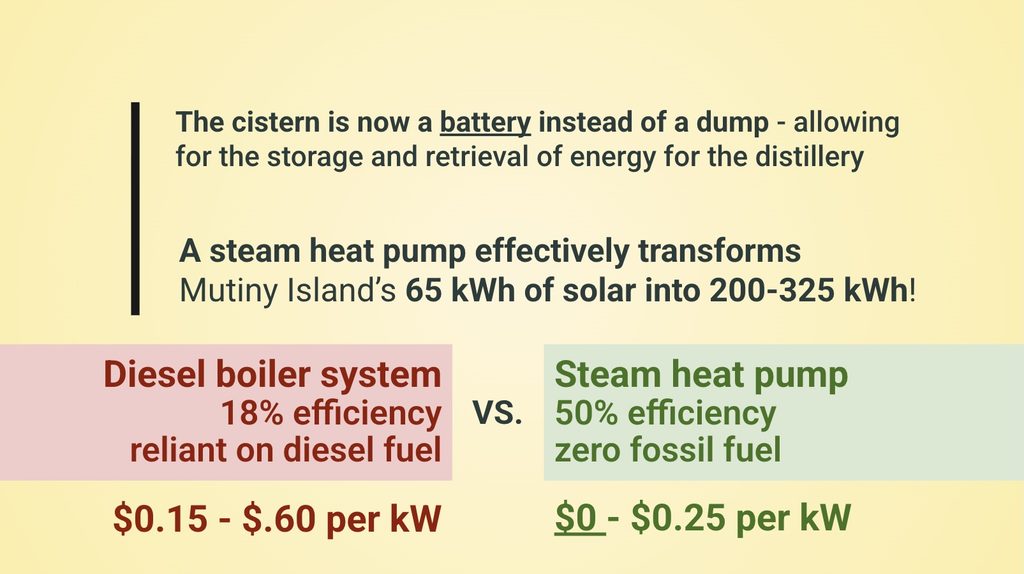
That thermal capacity helps separate the timing of solar generation from the timing of process demand. Instead of expecting every kilowatt of solar power to be consumed at exactly the moment it’s generated, the system can use available electricity to build useful thermal capacity and draw on that capacity later. Solar power, high temperature heat pumps, process heating, process cooling, and thermal storage stop being separate utility problems and start functioning as one integrated system.
Breadfruit Changes the Other Half of the Equation
Energy isn’t the only thing that gets shipped to an island. Most distilleries are designed around familiar fermentation sources such as grain, molasses, fruit, or other agricultural commodities supported by established supply chains. But if you’re already redesigning the energy system around what’s available locally, it makes sense to ask the same question about the raw material: what already grows there?
Breadfruit is an abundant starch source in many tropical regions and can be used as an alternative fermentation feedstock. That makes it more than an unusual ingredient. Instead of importing a conventional feedstock in order to reproduce a conventional product, the process can start with something native to the area and develop the fermentation and distillation system around it.
That’s what makes the concept more interesting than simply building a lower-energy distillery. The same design logic is being applied to both sides of the project: use the energy that’s available locally, and use the agricultural resource that’s available locally. The result is a process that starts to belong to the place where it’s being built rather than one that simply imports the assumptions of a mainland facility.
Design Around the Island
Solar panels, heat pumps, thermal storage, and breadfruit aren’t individually new technologies or ideas. The opportunity comes from putting them together in a way that responds directly to the conditions of the site. On a small island, imported fossil fuel is expensive, grid electricity is valuable, solar power is intermittent, cooling is a major process requirement, large battery systems may not make economic sense, and conventional fermentation feedstocks may need to be shipped in.
The better question isn’t how do you build a conventional distillery here? It’s what kind of distillery actually makes sense here? That’s the larger subject of the presentation: using solar power, high temperature heat pumps, thermal energy storage, integrated process heating and cooling, and breadfruit fermentation to rethink what an island distillery can look like when the process is designed around the resources and limitations of the place itself.
Watch the presentation here or view it at the official James B. Beam Institute youtube page.
Want to Learn More?
If you’re working on an island distillery, energy-constrained production site, industrial heat pump system, thermal energy storage project, or alternative fermentation feedstock, contact The Engine Room for more information or to request the complete presentation. Let’s start a conversation.